No, no, this is not a Neil Young song! Stick with me, and you will understand. Let's begin:
Hands to Work
Hearts to God
This is the Shaker motto.
Although renowned for their practical, utilitarian furnishings and austere dress, the Shakers did have a very creative and colorful aesthetic. Simple furniture was artfully crafted out of quality products highlighting the natural beauty of the object. While personal dress might be demure, the Shakers got their color groove on with decorative arts, such as chair seat weaving. (Chair Seat Weaving for Antique Chairs, Marion Burr Sober, 1964.)
This appreciation for natural, understated beauty--a combination of quality, practicality and visual appeal--is the essence of the Shaker design tradition: Natural beauty that one wants to be around and among for the sake of beauty itself. This sounds reminiscent of the tale of Endymion retold by Keats:
A thing of beauty is a joy for ever.
Its loveliness increases; it will never
Pass into nothingness; but still will keep
A bower quiet for us, and a sleep
Full of sweet dreams, and health, and quiet breathing.
Therefore, on every morrow, are we wreathing
A flowery band to bind us to the earth,
Spite of despondence, of the inhuman dearth
Of noble natures, of the gloomy days,
Of all the unhealthy and o'er-darkened ways . . .
Now, the Shakers probably would not have taken to this comparison from the 1800's Keats poem, inspired by the ancient Greek myth of a gorgeous shepherd adored by the goddess of the moon, Selene. It is Endymion the shepherd who is so beautiful that Selene begs her father Zeus to keep Endymion in a semi-immortal state and partially asleep so that she can entreat him. (He's apparently very handsome while sleeping--sounds like an Aerosmith song I recall--but another time--I digress.) They end up having 50 children! Oy vez!
This natural, unadorned beauty while sleeping is actually much like the Shaker aesthetic. This concept is also aligned with the classical Greek ideal of beauty and the Aristotelian Golden Mean. Natural, unadorned, devoid of posturing or extremes, the Golden Mean espoused by Aristotle held beauty as pure and the signature example of perfection of the form--neither ostentatious nor primitive.
The Greeks ascribed to beauty these three attributes:
symmetry, proportion, and harmony.
Coincidentally, the only class in college that Mr. Artifact and I took at the same time was Ethics--and we studied this concept of the Golden Mean. I got a B+ (my best grade that semester). He got an A. I actually remember this stuff, and he actually does this stuff. (Hmmm. . . well, a B+ is pretty good. OK, well, I write about it. How's that?) I distinctly remember our professor discoursing on this theme and entreating us to visualize the perfect chair. Seriously! A perfect chair is useful and beautiful. "What would that be?" he asked. 30 years later, I can say definitely, "It's a Shaker chair."
Basically, Aristotle's Golden Mean is an articulated place between two extremes that is the perfect position. Moderation is the key virtue in this philosophy. If you are an engineer I suppose you would call this the "angle of repose" (note to self: blog about Wallace Stegner). If you are a chair officinato, you'd call this a Shaker chair.
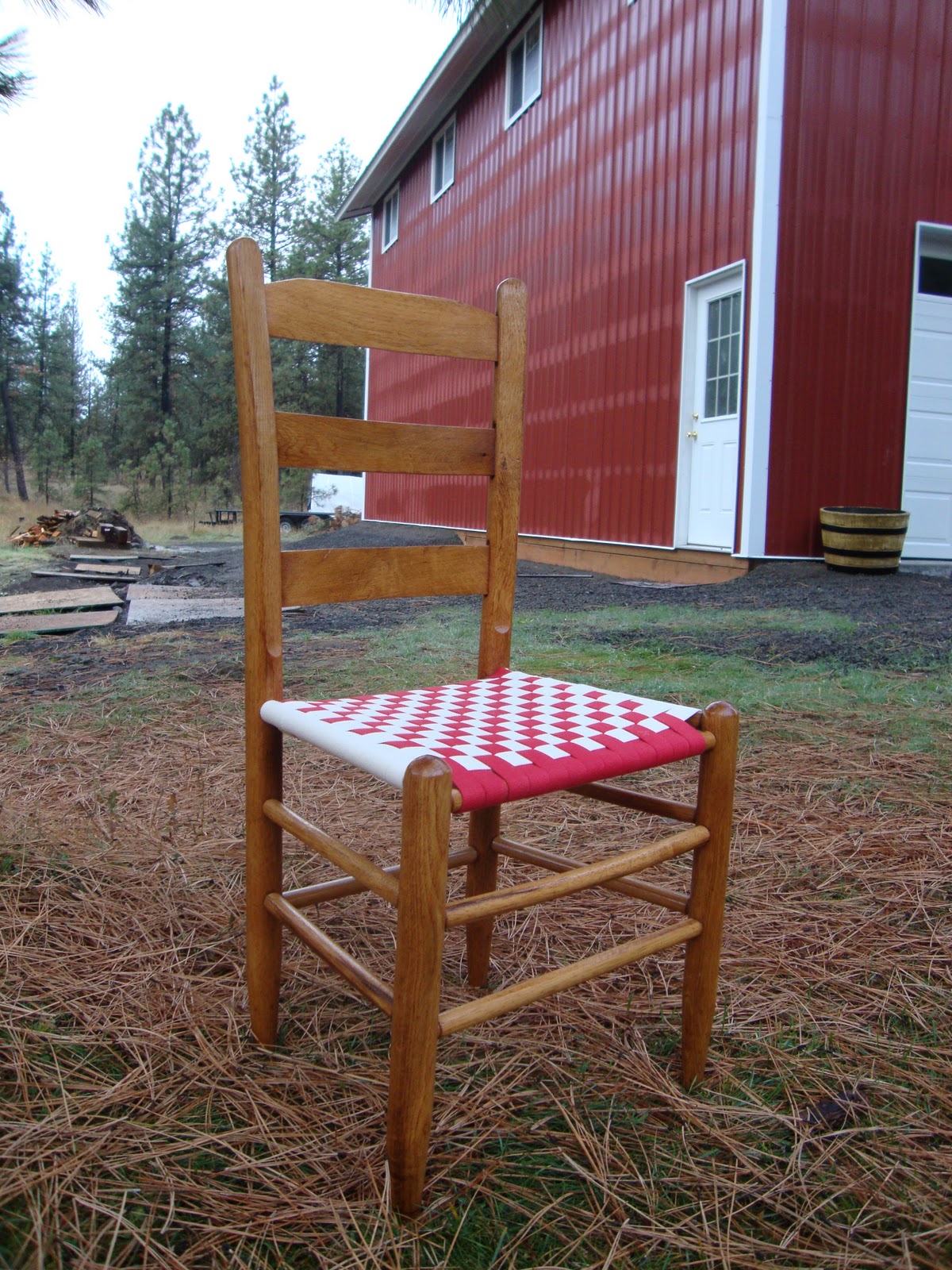
So, from the ancient Greeks to the Shakers, I bring you Mr. Artifact's renovation of the Shaker style chair.
 |
| This chair is one of a pair previously covered with a split wood basket weave. |
The bottom had fallen out long ago in this chair. Mr. Artifact refinished the wood and re-wove the seat in cotton Shaker tape with a red and natural color. In between the top and bottom layers is a foam cushion to give the chair more heft. For techniques and materials, check out the basket makers catalog. They have great on-line tutorials as well as all the materials you will need.
 |
| The Golden Mean is put to purpose. |
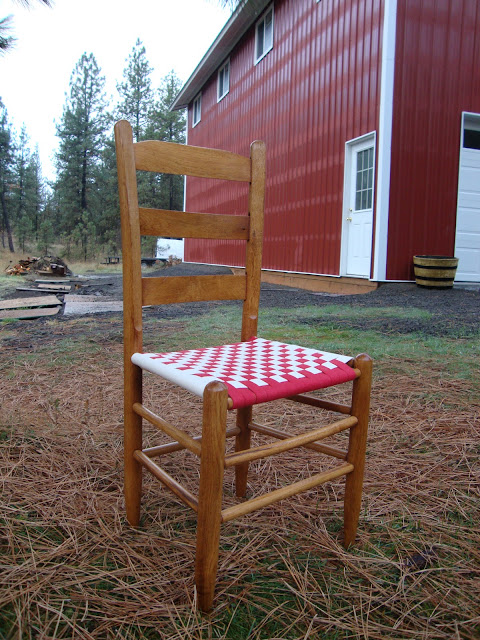 |
| Great chair for a banjolele concert and it even matches the barn! |
In the interest of academic integrity, I must confess that I had relational knowledge of all these factoids from my General Education undergraduate experience, but I refreshed this understanding with a visit to Wikipedia. But, thank God for a liberal arts education! Usefulness is one thing, but understanding is. . . priceless.
P.S. By the way, I do want to thank my elementary school teachers for instilling in me a profound understanding of Doric, Ionic and Corinthian column design. I love you all! 40 years later, I am still looking up when in old buildings to see evidence of your lesson plans!